




Overview
Kaiser Permanente wants to change the way its members on high deductible plans interact with healthcare costs.
Team
My role was as one of four Service Designers, in a team of 8-9 that included a project lead, project manager and subject matter experts.
Tools & Methods
- Design strategy
- Service design
- Contextual inquiry
- Field observations
- Qualitative interviews
- Usability testing
The Problem
Kaiser Permanente is one of the largest integrated healthcare providers in the USA, servicing members with traditional HMO and deductible HMO plans. Members on deductible plans can end up confused and frustrated when dealing with their healthcare and its associated costs due to the ways in which cost is currently communicated to them. The Consumer Finance Service Experience group engaged the Innovation Consultancy to think outside the box and deliver an entirely different healthcare and financial experience for these members.
The Solution
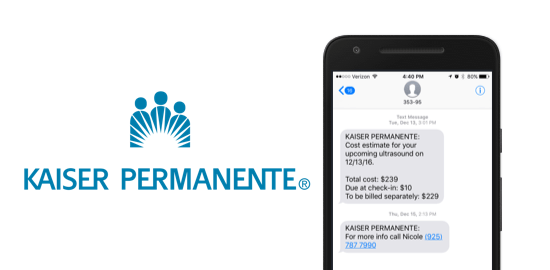
Our solution was to provide members with relevant information related to their care and its costs at the right moment in time. We embraced the design thinking process and worked in sprints. We conducted research via field observations, contextual inquiry, interviews and secondary research. These were then synthesized into insights to drive design solutions. The final phase was to validate these solutions by building prototypes that were tested out in the field and by conducting co-design sessions with members and KP employees.
The Process
We need to empathize and understand to innovate
We dedicated the first phase of the project to conducting research, diving deep into both the members’ experience of healthcare cost as well as that of KP employees. Our primary research centered on interviews with 9 Kaiser Permanente members on deductible plans. These interviews were intentionally conducted in the members’ homes to allow us to really connect with them. The interviews focused on the members experience with healthcare, cost, general finances as well as their thoughts on any form of communication they’ve had with the organization.
On the other end of the spectrum, we also wanted to see how cost was thought of and presented by the employees of the organization. To understand this, we conducted numerous other types of research, including:
- contextual inquiry with financial services call center employees
- interviews with doctors
- interviews with facility administrators
- field observations of check-in, laboratory, imaging and pharmacy employees

Define and scope the problem
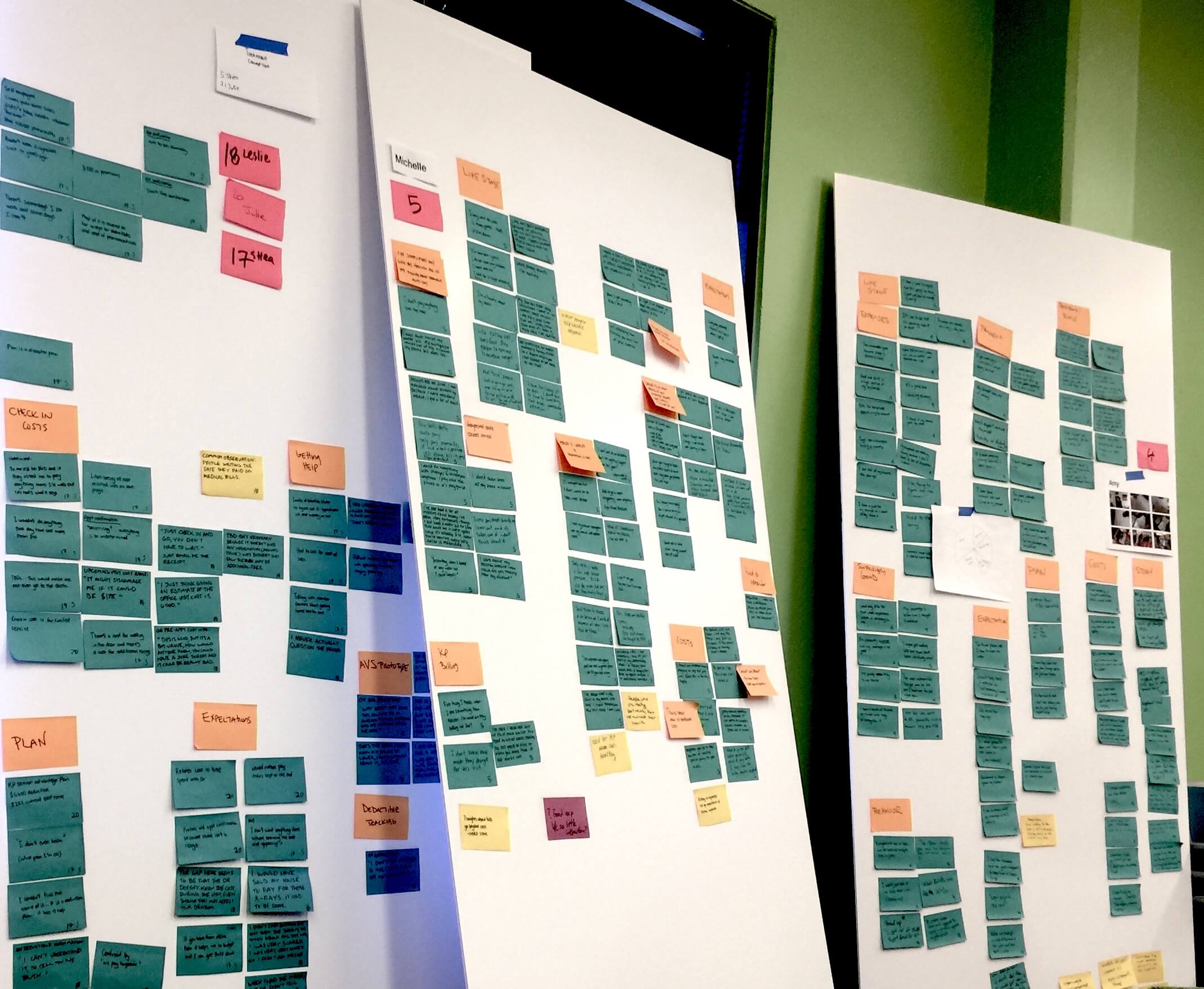
Coming out of the research phase, we needed to make sense of all the data collected. Using a large room, countless poster boards and an endless supply of post-its, we did a data dump, initially organizing the information collected by the different types of research above. We then went through several rounds of synthesis, noting patterns in our research to come up with insights from both the members’ and organization’s perspectives.
Life gets busy, and people don't think about the cost of healthcare until it's too late
The end to end process of healthcare involves many stages, and potentially with breaks in between, such as the time between when service is rendered and when a bill is received. Due to the project timeline, the scope of this phase was narrowed down to the specific moment between when an appointment has been scheduled and when the member actually obtains the service. We were also focused on specific type of members scheduled for elective care.
Be creative and ideate
Using the research findings and scope of the work, we ran a few brainstorming sessions to generate solutions. Solutions were presented, voted on and refined to solve the following issues:
- provide members with a bigger picture overview of the cost of care
- provide members with only the relevant information related to their care and its costs at the right moment in time

It's ok to fail, as long as you learn from it
The final phase of the project involved 4 weeks dedicated on-site at a Kaiser Permanente facility, where we designed, tested and validated our hypotheses and prototypes from the synthesis phase.
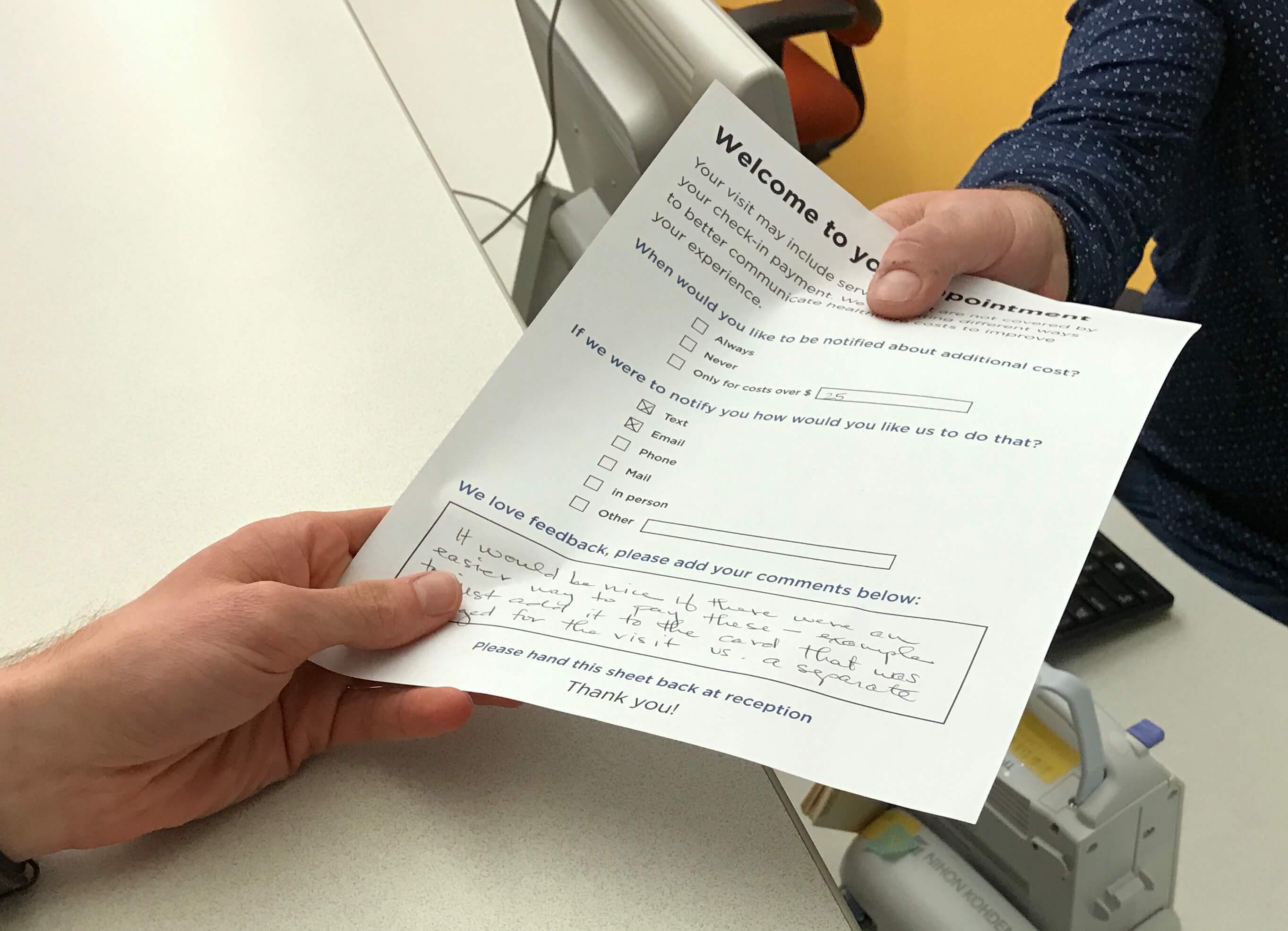
Using quick surveys presented to members at check-in, we tested some of our assumptions:
- members have thresholds for when they want to know about the cost of care
- members prefer to communicate with KP via text and email
It's important to think of when, how and what cost information is presented to members
In the context of cost of care, its not just the information that’s presented that matters, its also about when its presented because this helps the member plan for that cost and also how its delivered as members have different preferences in channels of communications.
We completed this deep dive with a presentation to the larger workgroup and the CFSE.
Next Steps
The intent of the deep dive was to show proof of concept. The Innovation Consultancy shared our research findings and prototypes to tactical groups within the organization to implement the solutions.